The Arkbreaker Series
The Resonant
Humanity thought it had mapped the stars.Then the signal arrived.When experimental vessel TFS-993 Resonant responds to an unidentified transmission, Captain Kate Monroe and her crew uncover a relic older than civilisation itself, one that may reshape humanity’s place in the galaxy.The Resonant is book one of a new science fiction series and is available to buy now. I'm also 20 chapters into book two which I hope to publish before the end of 2026.
A New Space Opera
The Arkbreaker Series
Space is vast, but the routes through it are not.For decades, humanity has travelled between the stars using a system of naturally occurring corridors known as Vault nodes. The network has transformed exploration, allowing ships to cross enormous distances with a degree of predictability that earlier generations could only imagine.Most of the nodes have been mapped. Some have not.When Fleet vessel TFS-993 Resonant intercepts an anomalous signal within the network, Captain Kate Monroe and her crew are tasked with investigating what appears to be a routine transmission error.It is anything but routine.What they uncover suggests that the Vault network may not be a natural phenomenon at all, but part of a much older structure, one that spans far beyond the regions humanity has explored.And the signal they detected may be the first sign that someone, or something, is still using it.
TFS-993 RESONANT CREW
Meet The Crew
The crew of the Resonant was assembled from across Fleet’s most specialised divisions: command, science, intelligence, and a marine detachment trained for operations far beyond known space.At the centre of the mission is Captain Kate Monroe, a pilot raised on the frontier and chosen to command the experimental vessel TFS-993 Resonant. Alongside her are weapons specialist Anita Shah, science officer Tom Avery, and Sergeant Jack Carver’s marine squad. I'm personally rather fond of Elias Renn, Chief Systems Architect who you'll meet in the prologue - see the teaser page below.Each brings a different expertise. Together they form the first team sent to investigate a signal from beyond mapped space.
Behind the scenes
About the author
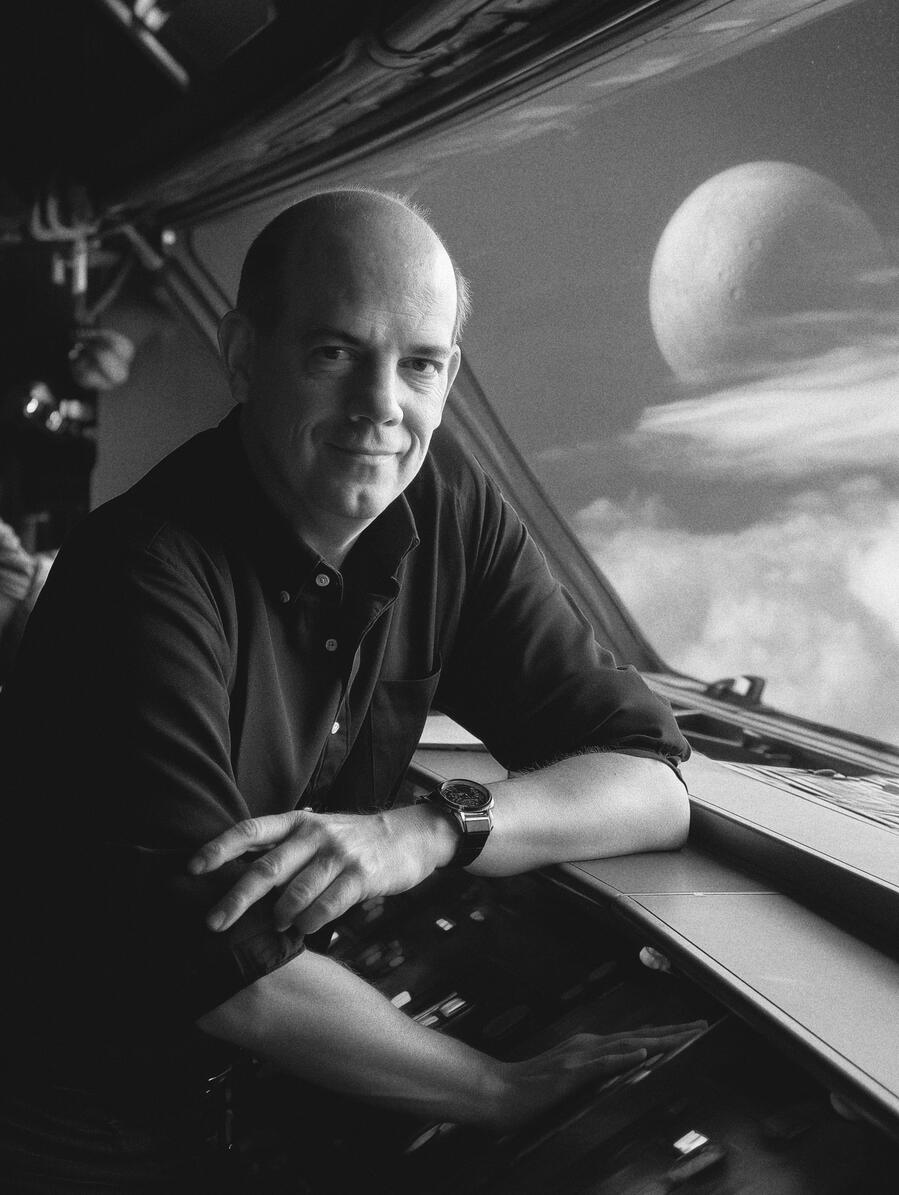
Samuel S Barton is a writer, photographer, and technology leader based in the UK.Raised around visual storytelling, he grew up in a house filled with books, with his film-producer father always searching for the next story to bring to the big screen.His formative years were spent working in photography alongside exceptionally talented creatives, helping produce compelling images for magazines or major print campaigns. That early exposure to visual narrative left a lasting impression, and he still enjoys capturing otherworldly locations across our remarkable planet.Alongside his creative work, Sam has spent more than twenty years building technology companies and leading engineering teams as a Chief Technology Officer. His fascination with complex systems, artificial intelligence, and human decision-making now informs the scientific realism and technical depth of his fiction.His debut novel The Resonant launches The Arkbreaker Series, a cinematic hard-science-fiction saga exploring humanity’s encounter with technologies far older than itself.When not writing, Sam is usually travelling for photography, printing images in his studio, or planning the next expedition.
Test Drive The Resonant
Prologue
The orbital laboratory above Kheris-9 sat in near darkness, a graphite spindle with a broad ring that turned slowly, keeping time with the large orange planet below. Its position had been carefully chosen, the planet was rich in heavy metals and poor in anything worth colonising. Fleet I&R maintained facilities in places most officers never saw, their location as covert as their work. Admiral Jonathan Reeve watched it loom in the forward screen as his shuttle approached, the lab’s running lights glinting in clean intervals along its rim. Kheris-9 slipped below them, a bruised crescent mottled with storms that brushed the hemisphere with flickers of lightning.The escort pilot spoke without turning. “Docking corridor open. Clearance granted.” Reeve gave a single nod and checked the seal on his wristband. He had been on enough stations to recognise the smell of recycled air before the hatch even cycled, the sterile tang that told you every breath had been filtered many times over. The shuttle slowed, leaning into the docking arm, and then drifted back until the magnetic locks engaged. A gentle vibration ran through the floor of the station as it accepted their mass and captured it within its gravity well. A technician in I&R blues met him at the airlock, his posture was casual and without the sharp salute of Fleet personnel when greeting a ranking officer. “Admiral. Welcome back.” Reeve wasn’t one for formalities, he preferred his people to direct their energy into their work, not on him. Reeve stepped through, his boots landing on deck plating scarred by heavy loaders. The curved walls of the corridor beyond were a dull grey, accented by bright white ceiling lights that cast thick shadows along the bulkheads. There were no windows, or views, just guidance strips and numbered floor markers. Despite the station being at the cutting edge of science, it had the utilitarian design of an older era.The two men walked in silence, navigating the busy passage. They moved to one side to let a grav-cart pulling unmarked yellow crates pass in the opposite direction, its undercarriage warning lights reflected on the ground behind it.
The wall opposite had a sealed hatch with a crimson stripe across its frame. The technician didn’t look at it. Reeve did. “Still locked down,” the technician offered quickly. “Storage and analysis continues under restricted protocols. Renn’s orders.” Reeve nodded once, neither asking the obvious nor pretending he hadn’t noticed the extra guards.The lab’s main chamber opened into a space that reached up several hundred feet, its cylindrical walls narrowing in the centre and encircled by walkways and gantries. In the centre hung the core assembly, a ringed structure of composite and alloy, suspended in a clear cradle designed to replicate the pressure of containment. The floor was littered with conduits of varying sizes, some pumping coolant into the tube, excess gas escaping along the edges. The Helios prototype was not beautiful in the traditional sense. It was functional and uncompromising, and that was its own kind of attraction. Reason enough for Reeve to travel this far for an update.
Chief Systems Architect Elias Renn stood on top of a scaffold tower that was as tall as the containment cradle. His sleeves rolled to the elbow, hair untidy, a stylus tucked behind one ear. He was out of uniform, as always, wearing overalls with a Fleet badge stitched on as a formality rather than out of allegiance.He looked down at Reeve and furrowed his brow. “You’re late.”
Reeve’s expression softened a fraction. “You’re still rude.”
Renn stepped down from the ladder and met him at the rail. Up close his eyes were bloodshot, displaying the kind of fatigue that came from too much work and a passion that ensured he always remained busy.
“You wanted an update,” Renn said, “It's probably best if we go to my office”.Renn’s office was a container that had been dropped in the centre of the chamber. A makeshift staircase led up to the only door and next to it a single window looked out at the cradle. The narrow room was both office and bunk, Renn blurring the lines between work and life. He walked to his desk and pulled a bottle of whiskey from a cabinet. “Drink?” he asked, not looking up.
“I’ve no idea what time it is.” Reeve replied, in a tone that implied acceptance. Renn poured two drinks, and pushed one towards Reeve, gesturing for him to sit in the only other chair.
“Trial three,” Reeve said. “Talk me through it.”Renn paused, his eyes closed as he savoured the liquid. “The first two trials were about stability and containment. This is a fuel cell unlike anything else we have seen. We needed a baseline.” Reeve nodded, he knew this, but he also knew Renn needed to let it out. “With that established we wanted to test jump simulations, that required an increase in power output. Each test was designed around existing fleet ships, their propulsion, hull arrays, safety margins, navigation sequences. We basically built the bones of a Fleet frigate just to test this thing and after months of trials, nothing.”Renn drank the rest of his whiskey, taking a moment to himself. “Then, three weeks ago, it started to fall into place. We recorded an increase in output that matched all metrics for a viable Vault jump.” Renn shook his head, staring at his empty glass. “It was perfect.”
“What did you change?” Reeve asked, still holding his untouched drink.
“That’s just it, we didn’t change anything. At least nothing to do with the Helios core. There is a separate project being worked on here, you sanctioned it eighteen months ago. “The Neural Link Network?” Reeve asked, eyeing his glass. “Yes, exactly”, said Renn.Renn poured himself another drink and nodded out of the window. “It’s there, to the far right of the cradle.” There wasn’t much to see, a collection of fiber optic cables coiled over each other and suspended from two bars that straddled a large console. Reeve stood up and looked out of the dirty window. “What do those cables have to do with trial three?”
“What you can’t see from here is that they are connected to the cradle. A thin conduit along a coolant line. One we didn’t make.”
Reeve turned to look at him. “Who did?”, he asked, leaning his back against the glass. “Not who, what…”.Renn turned in his chair and motioned to the wide corridor. Reeve nodded, taking a slug of whiskey for the first time. “I saw the extra guards.”
Renn eased back in his chair, his head resting on the old leather fabric. “It's fine, we’ve got it under control. Once we understood it was about proximity we disconnected the systems. But only after the Helios core had demonstrated a successful simulated jump.” Reeve smiled and drank the last of his whiskey. This was exactly why R&D projects were buried out in uncharted space. He was grateful that he had found Renn first. The man took some getting used to, but he was ruthless in the pursuit of innovation.Continued in the book.
The Arkbreaker Series Begins Here
Buy The Book
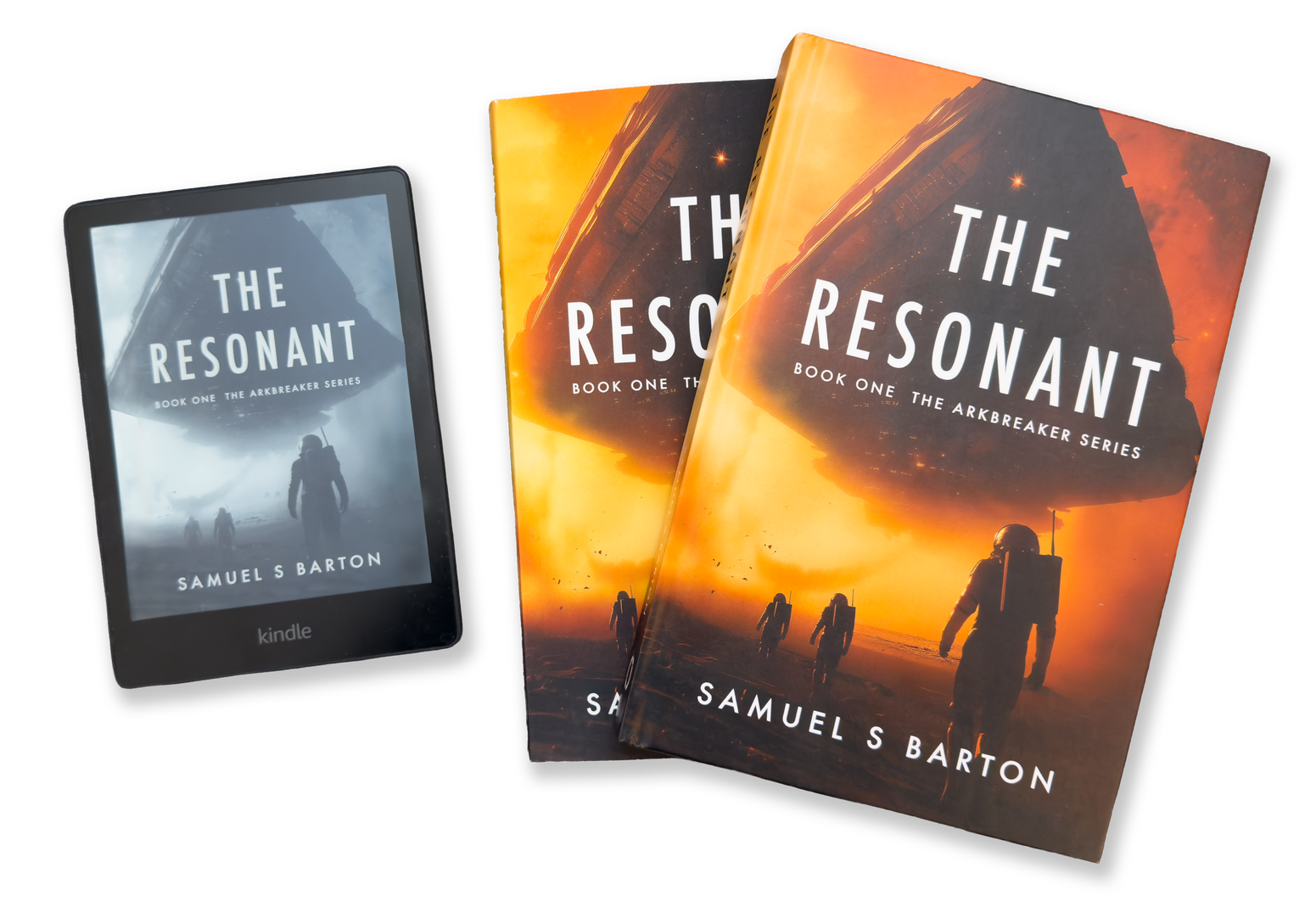
The Resonant is available to buy now on all Amazon websites, in Kindle, paperback and hardback.If you’ve enjoyed exploring the the Arkbreaker universe, you can own the book now using the links below.Or search for Samuel S Barton on your local Amazon store.
STAY IN TOUCH
Newsletter
Join the Arkbreaker TransmissionSubscribe to receive updates about upcoming books, new artwork, and early previews from the Arkbreaker universe.Occasionally I’ll also share behind-the-scenes material about the ships, technology, and worlds that appear in the series.No spam. Just the signal.
First Contact
Can't wait for the newsletter? I'm always happy to hear from readers.Send me a note here and I'll come right back to you.